
REGISTERED MY COMPANY WITH SSM — IS MY BRAND NOW Legally Protected?
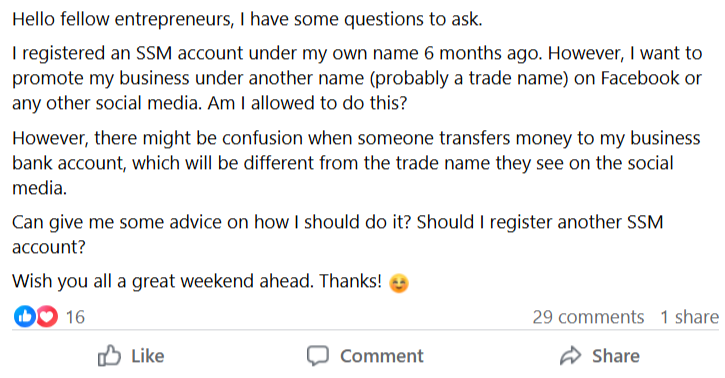
The above situation occurs more often than most people realise. Many business owners—especially new entrepreneurs without legal guidance—are often confused about whether registering their business with the Companies Commission of Malaysia (SSM) is sufficient to protect their brand or company name from being copied or misused by others.
What many business owners fail to understand is that there is a major difference between registering a business entity and registering a brand or trademark. Registration with SSM is governed under the Companies Act 2016, whereas trademark registration is governed under the Trademarks Act 2019. Both serve different purposes and provide different outcomes.
SSM REGISTRATION
Registering with SSM is essentially the process of formally creating your business entity. In simple terms, it is the “birth” of your company in the eyes of the law. This registration legalises your business and enables you to carry out important commercial functions such as:
creating a legal entity recognised under Malaysian law;
opening corporate bank accounts;
entering into contracts legally;
issuing invoices to customers;
operating a business lawfully and professionally.
Without legalising your business through SSM, you may still be able to carry out the activities above, but you do so entirely at your own risk. Operating an unregistered business may expose you to legal consequences, regulatory action, and difficulties enforcing your rights in the event of a dispute.
However, it is important to note that SSM registration does not automatically protect your brand name, logo, or product identity from being copied or used by others. SSM registration mainly regulates business entities and company names, but it does not grant full ownership rights over a brand in the commercial sense.
This is where trademark registration becomes important.
TRADEMARK REGISTRATION
Trademark registration is the process of legally protecting your brand identity, such as your:
brand name;
logo;
slogan or tagline;
product packaging design (in certain cases);
any sign that distinguishes your goods or services from others.
Unlike SSM registration, which focuses on the creation of a business entity, trademark registration focuses on protecting what your customers actually recognise in the market—your brand.
In Malaysia, trademark registration is governed under the Trademarks Act 2019, and it is administered by the Intellectual Property Corporation of Malaysia (MyIPO).
Once a trademark is successfully registered, the trademark owner is granted exclusive rights to use the mark in relation to the goods and services registered under that trademark. This means that others are not allowed to use a similar name, logo, or branding that may confuse consumers into believing that their products or services are connected to yours.
Trademark registration provides strong legal protection, including the right to:
stop others from using identical or confusingly similar marks;
take legal action against infringers;
claim damages or compensation;
prevent others from registering the same or similar trademark;
increase business value and credibility, especially for franchising or expansion.
Most importantly, trademark registration gives you a stronger legal advantage when dealing with “copycats” who attempt to ride on your reputation and goodwill.
WHY SSM REGISTRATION IS NOT ENOUGH
Many business owners mistakenly believe that once they register their business name under SSM, they automatically own the brand and can prevent others from using it. This is not entirely true.
A business may be registered under one name with SSM, but operate commercially under a completely different brand name. For example, a company registered as ABC Trading Sdn. Bhd. may market its products under the brand “Glow Beauty”. SSM registration does not prevent another party from using “Glow Beauty” as a brand if it is not protected under trademark law.
This is why “copycats” can still exist even when a company is already registered with SSM. SSM does not have the authority to stop someone from using a similar brand name in the marketplace, unless it directly involves company name registration issues.
WHAT HAPPENS IF YOU DO NOT REGISTER YOUR TRADEMARK?
If you do not register your trademark, your legal protection may be limited. You may still have certain rights through common law actions such as passing off, but such claims are often more difficult, more expensive, and require strong evidence to prove your reputation and goodwill.
In some situations, the person who registers the trademark first may gain the stronger legal position, even if you have been using the brand earlier but failed to register it.
Therefore, without trademark registration, business owners may face the risk of:
losing their brand name to another party;
being forced to rebrand;
losing customers due to confusion in the market;
being unable to stop others from copying their business identity;
expensive legal disputes that could have been avoided.
CONCLUSION
In summary, registering with SSM is important because it legalises your business and allows you to operate properly under Malaysian law. However, SSM registration does not provide full protection over your brand.
To properly safeguard your business identity, reputation, and market presence, business owners should consider trademark registration under the Trademarks Act 2019. This is the most effective step to prevent others from misusing your name, logo, or branding for their own advantage.
